Day 1 — Learning From the Everyday
From the series: 25 Things I Learned in 2025

Make - As an architect and co-operative practitioner, I design regenerative, biophilic spaces that support health, equity, and environmental restoration.
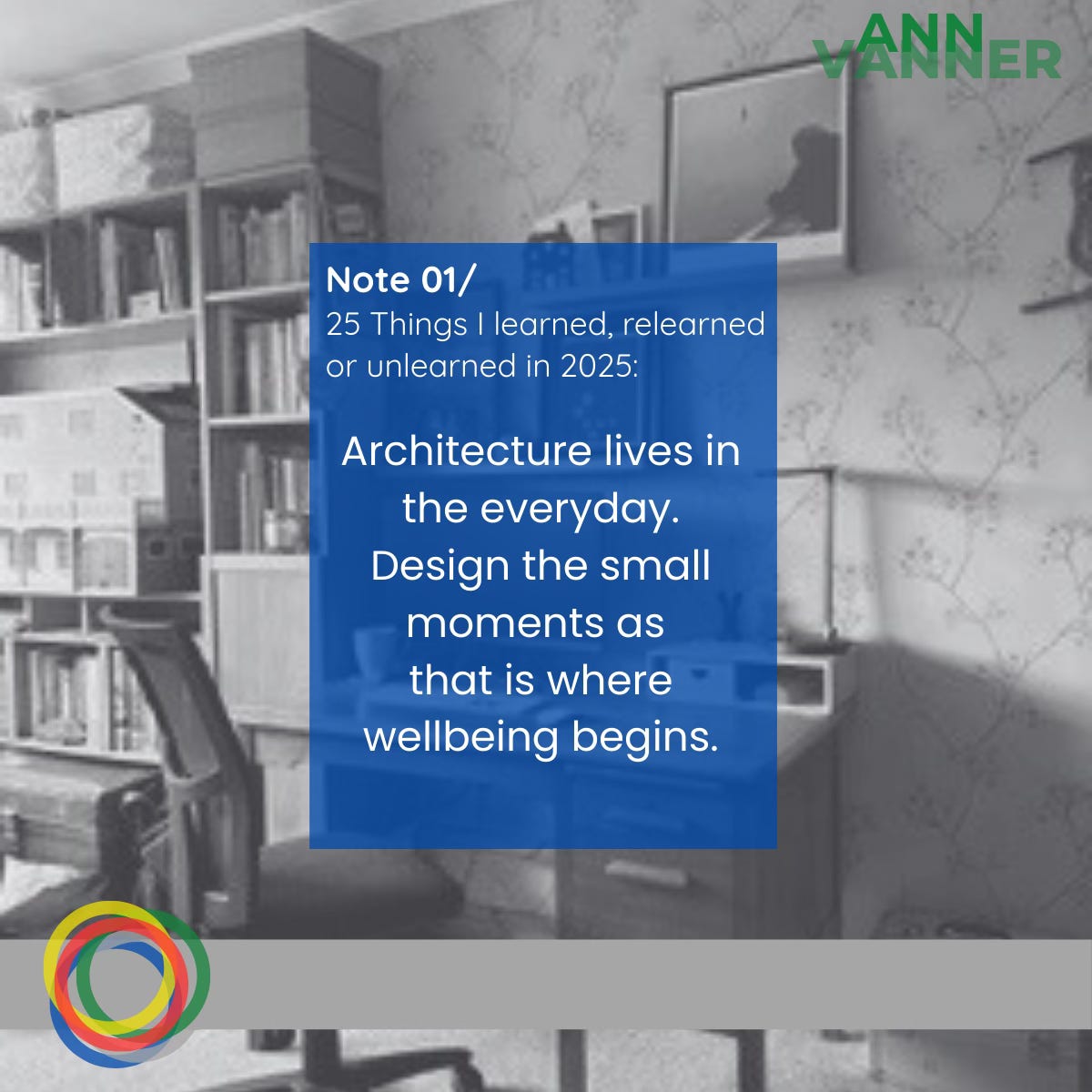
This year has reminded me that the most powerful lessons in architecture don’t come from the exceptional, they come from the everyday. The small, repeated, ordinary moments that make up 99% of how we actually live. The moments that rarely get photographed, celebrated, or even noticed. And yet those are the moments that shape our wellbeing the most.
We pay attention to signature buildings, hero details, glossy concepts and big gestures. But life happens in the places between: the hallway you use 20 times a day, the corner where you rest your coffee, the familiar window where light lands differently each morning as the season change
If architecture is meant to support life, then the everyday is the real project.
Learning from the everyday means slowing down long enough to observe what people actually do, not what we assume they do. It means accepting that comfort is not a luxury, it is a foundation for health. It means noticing the places where friction builds and asking whether design is helping or hindering. And it means letting the small things matter. Because people feel the small things long before they notice the big things.
As someone committed to regenerative, biophilic and health-centred practice, I’ve realised that wellbeing doesn’t come from one green wall, one airy room or one beautiful moment. It comes from the continuous thread of small experiences that either support or erode us. Salutogenesis, the idea of designing for health rather than avoiding illness lives in the everyday. So does biophilia. So does comfort, agency, dignity and ease.
The everyday is where architecture quietly does its job. Or quietly fails.
This year, I am reminded that if we only design the special moments, the statement staircase, the fancy entrance, the one “Instagrammable” view- we design for an audience, not for the people who actually live and work in the building.
But if we design the everyday intentionally, materials that calm, light that soothes, corners that welcome, edges that feel safe, people feel it. Their nervous systems feel it. Their routines shift. Their stress levels shift. Their sense of belonging shifts.
Learning from the everyday is not romantic. It’s practical.
It is choosing to design with empathy.
It is choosing to notice what is usually unseen.
It is choosing to care about the 99% of life that people rarely articulate.
And for me, that’s what MAKE is about.
The everyday deserves great design. Because that’s where we spend our lives.