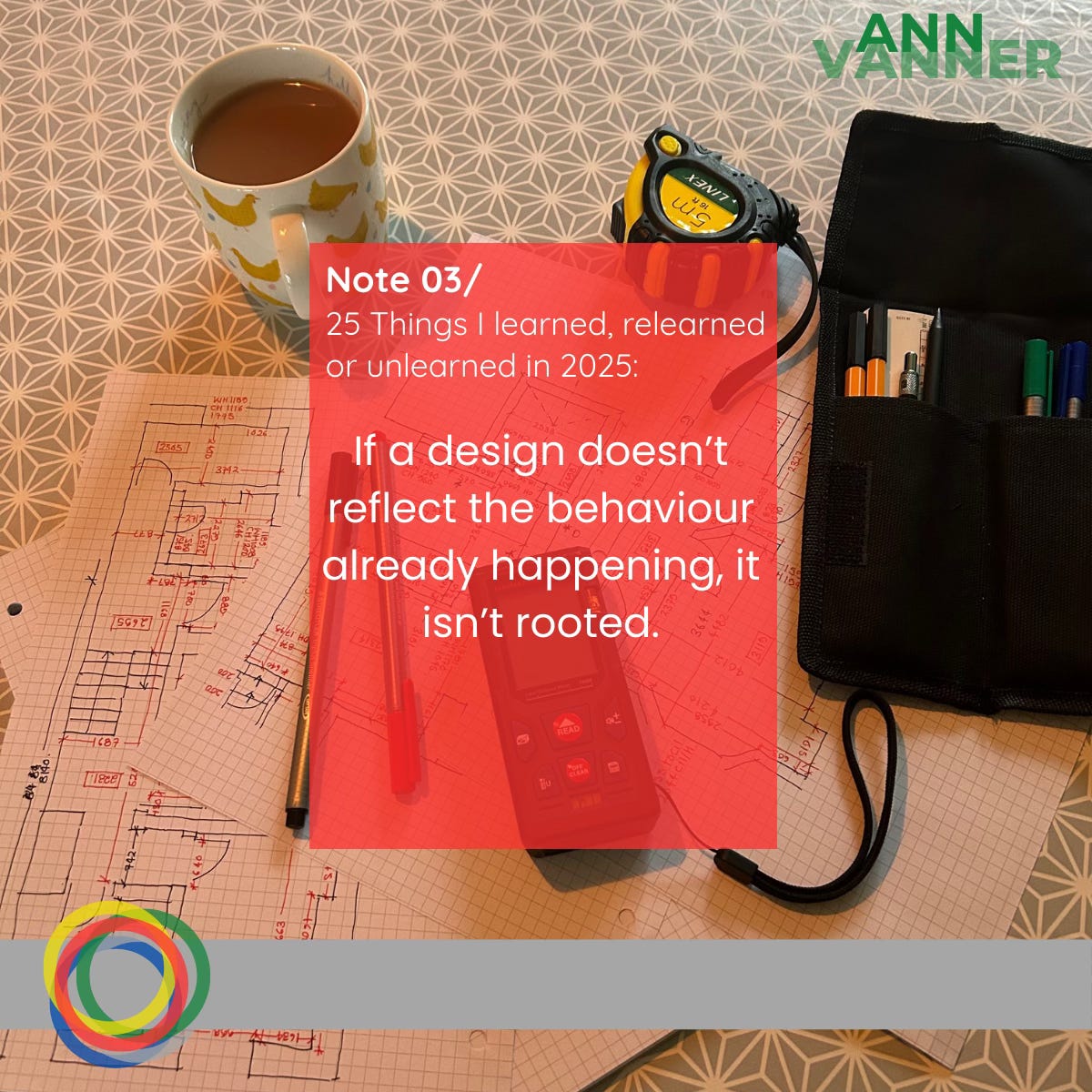
Day 03 : Hyperlocalised Architecture
25 Things I’ve Learned, Unlearned & Relearned in2025

I keep coming back to this: architecture works best when it responds to what people actually do.
Not what assumptions say they do.
Not what programmes imagine they’ll do.
Not what the “standard detail” expects them to do.
Hyperlocalised architecture starts with behaviour.
Real behaviour. Repeated behaviour. The behaviour the building reveals whether we notice it or not.
It’s the way someone always cuts across the grass instead of following the path.
The way the back door becomes the true entrance.
The way the cat occupy the same patch of warm floor every morning, though moving around the house seasonal as the sun moves through rooms and time.
The way a window is ignored because it looks onto nothing meaningful.
The way neighbours pause at the same centimetre of threshold to talk.
These tiny truths are not small.
They are the architecture already happening before a building is built.
When we ignore them, we design friction.
When we honour them, spaces feel inevitable, as if they were always meant to be this way.
Hyperlocality asks different questions:
What actually happens here?
Where do people naturally gravitate?
What rhythms already exist?
What rituals need protecting?
What frictions keep repeating because no one has ever designed for them?
What I keep relearning is that the smallest moves often matter the most.
Rotate a window to face the real moment, not the façade.
Shift a bench to where people already wait.
Create a nook where someone always curls up.
Widen the space where conversations pause.
It sounds simple, but it’s not simplistic.
It’s rooted. It’s attentive. It’s honest.
There’s a quiet power in designing from what is already happening, not what might happen, not what should happen, but what life is already doing without permission.
The work always brings me back to this:
Design from the behaviours already shaping the place.